


What the cold really does to your skin at high altitude
At high altitudes, the skin faces a unique combination of aggressors: cold that constricts blood vessels, wind that wears down the protective film, UV rays amplified by snow, and dry air that causes dehydration. Understanding what is truly happening allows you to respond without excess, using the right techniques and the right active ingredients.
It only takes one day at altitude to feel it: the skin feels tight, reddened, and dried out. It’s not your imagination, nor just a winter whim. At high altitudes, skin faces a combination of aggressions it encounters nowhere else.
In Megève, where Pure Altitude was born, we have been observing these reactions for years. The cold, the wind, the UV rays reflected by the snow, the dry air of the peaks: each one leaves its mark. Understanding what is truly happening is the first step toward addressing it correctly.
The good news is that skin that is well cared for can navigate the mountains without suffering all the effects. You just need to know what it is facing, aggression by aggression.
Here, without dramatizing or exaggerating, is what the mountains do to your skin, and the actions that help it cope.
Altitude changes everything: understanding the aggressions
The higher you go, the harsher the environment becomes. The air becomes thinner, humidity drops, and radiation intensifies. The skin, however, remains the same: a thin barrier a few tenths of a millimeter thick.
What weakens it at altitude is never a single factor, but the sum of them. The cold constricts, the wind sweeps, the sun burns, and the air dries out. Individually, each is manageable. Together, they overwhelm the epidermis’s natural defenses.
Temperature fluctuations add extra pressure. Moving from the biting cold of the slopes to the dry heat of a heated chalet several times a day relentlessly stresses the skin’s adaptation mechanisms.
This is why a routine designed for the city is rarely enough in the mountains. The skin doesn't need more products there, but rather answers adapted to specific aggressions.
The cold and the skin barrier: what really happens
The cold has a direct mechanical effect: it constricts surface blood vessels. Microcirculation slows down, the skin receives less oxygen and nutrients, and cell renewal shifts into low gear.
The result: a dull complexion, skin that repairs less quickly, and a persistent feeling of discomfort. The lipid barrier also stiffens under the effect of the cold and allows more of the water it is supposed to retain to escape.
This phenomenon has a name: transepidermal water loss. Invisible to the eye, it increases as soon as the barrier weakens, and the cold exacerbates it by drying out the ambient air. The skin empties of its water without us even noticing.
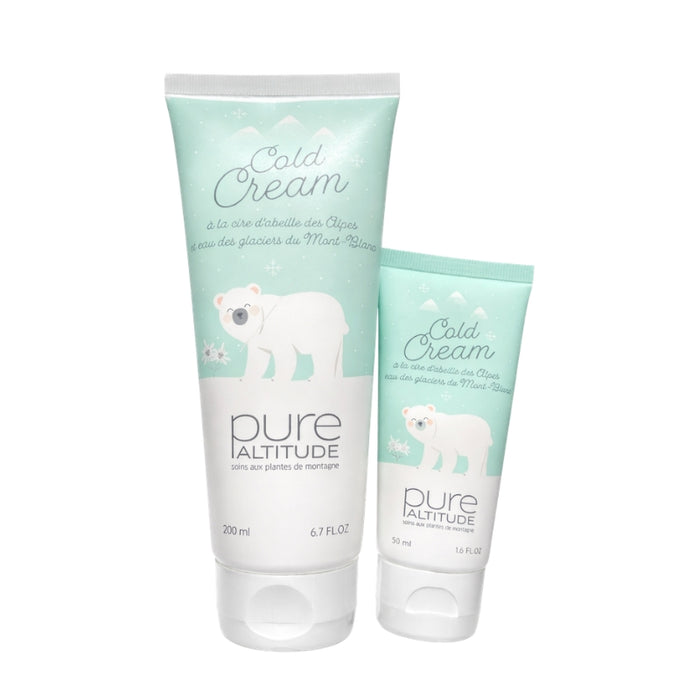
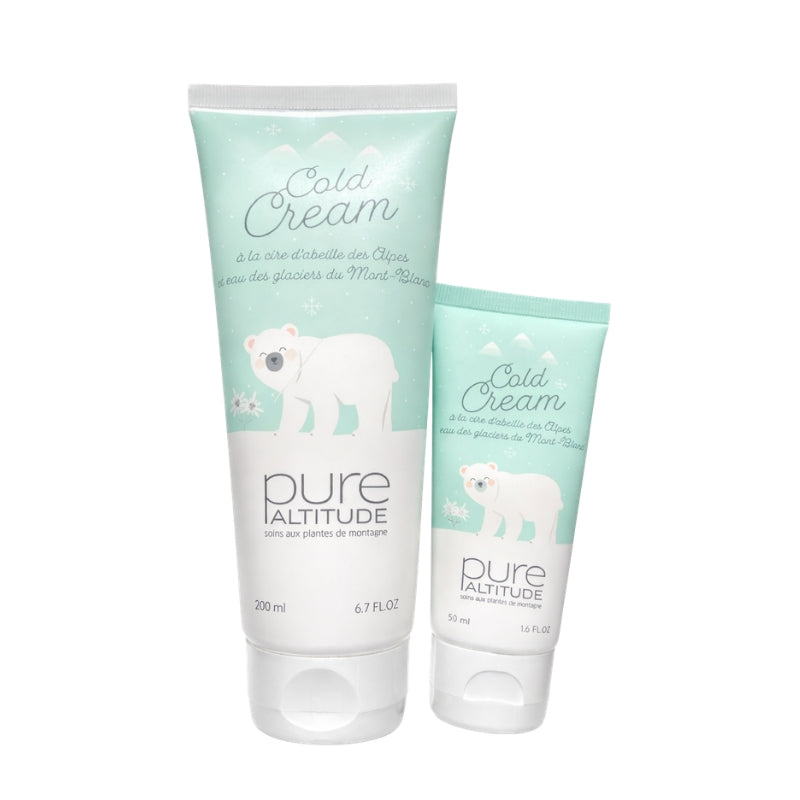
Facing extreme cold, it therefore demands a real protective layer. Pure Altitude’s Cold Cream, with beeswax and Mont-Blanc glacier water, acts like a down jacket: it forms a nourishing film that insulates from aggressions and limits dehydration.

Advice from the Ferme de Beauté: Apply your protective skincare at least twenty minutes before going out. The skin needs this time to absorb it; applied at the last minute, a fatty substance can, conversely, promote the effect of the cold on exposed areas.
UV in the mountains: the invisible aggression
We associate the sun with summer, rarely with the biting cold of a ski slope. That is a mistake. At altitude, UV radiation increases by approximately 8 to 10% for every 300 meters of elevation gain.
Added to this is the snow, which reflects up to 80% of UV rays. The skin then receives a double dose: the direct radiation from the sky and that reflected by the ground. The face is exposed from every angle, even in the shade.
Some areas pay a higher price for this exposure: the nose, the lip contour, and under the chin, often forgotten because they are reached by reflection alone. The cold, by slightly numbing the skin, also masks the usual warning signals.
This aggression is invisible and painless at the time, which makes it all the more insidious. Yet it contributes to skin aging and weakens a barrier already put to the test by the cold. Suitable sun protection remains essential, even in cloudy weather.
The wind: the forgotten enemy
The wind is the factor we neglect the most. We think of cold, we think of sun, and we forget this constant breeze sweeping across the face on ridges and chairlifts.
Its action is twofold: it accelerates the evaporation of water on the surface of the skin, and it mechanically wears down the protective hydrolipidic film. Combined with the cold, it creates that burning sensation and those rough patches well-known to skiers.
The faster the wind speed, the more the perceived temperature drops: this is the wind chill effect, which can cost exposed skin several degrees. The contour of the face, the only part exposed under a hat and neck warmer, takes the brunt of the impact.
Skin exposed to the wind loses its water faster than it can replace it. The answer can be summed up in two words: repair and insulate, to rebuild what the breeze has carried away.
The signs your skin sends: what they mean
The skin speaks, provided you listen. Tightness signals a weakened barrier that is letting water escape. Redness reflects microcirculation battered by the cold and wind.
Flakes and rough patches reveal disorganized desquamation, a consequence of slowed cell renewal. A dull complexion, finally, is often the first sign of skin receiving less oxygen than usual.
These signals have one thing in common: they appear gradually and worsen if ignored. Skin that feels tight in the evening but is not helped will eventually become permanently marked over the course of a stay. Taking them seriously from the first few days changes everything.
They call for a nourishing and regenerating response rather than a simple scrub or a light moisturizer. The Pure Altitude Ultra-Regenerating Cream, enveloping and rich, nourishes the epidermis, helps it regain suppleness and comfort, and supports its ability to repair itself.

The formulation response: what Pure Altitude has developed
Responding to the aggressions of extreme cold requires more than classic hydration. It requires an active ingredient capable of functioning where life itself seems impossible.
This is the whole point of Antarcticine (Pseudoalteromonas Ferment Extract), an active ingredient derived from bacteria that live under the Antarctic ice sheet, in an environment of extreme cold. These microorganisms produce molecules that protect their cells from freezing and dehydration: exactly what skin stressed by altitude needs.
This logic resonates with us: drawing answers to the harshness of the mountains from the harshest environments. It is the same intuition that has guided the brand from Megève, focusing on plants and active ingredients born from the cold.
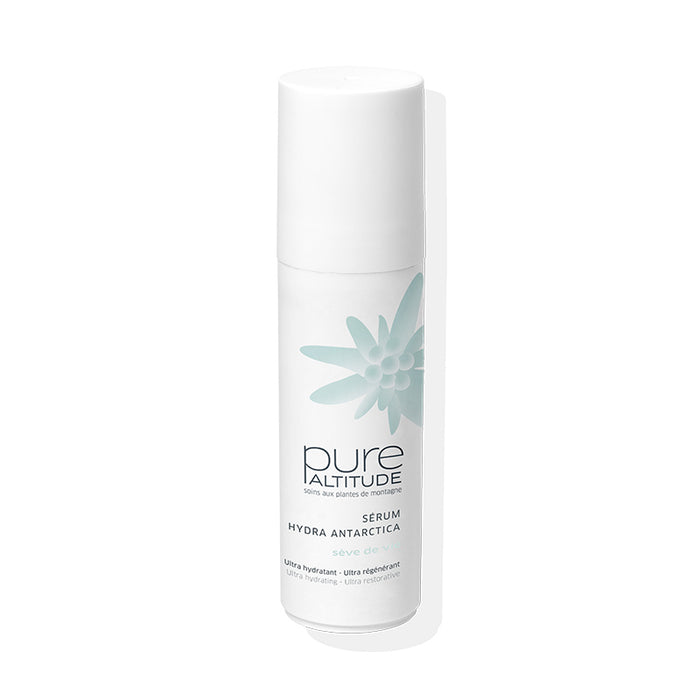
Pure Altitude is one of the few brands to incorporate this active ingredient. The Hydra Antarctica Serum makes it its core: a fluid texture that restores the skin’s water balance and helps it better resist temperature variations.

Applied under a rich cream, this serum forms the first link in a routine designed for the mountains: hydrating deep down, then nourishing and protecting on the surface. A simple logic, modeled on the way the skin naturally defends itself from the cold.
Morning and night, this two-step action is enough to support most skin types during a stay. Extreme cold or sustained wind call for an additional protective layer before each outing.
The mountains will remain demanding; that is also what makes them beautiful. But with the right actions, the skin can go through them without keeping the marks.
To compose your cold-weather routine, discover the Hydra Antarctica Serum and the Ultra-Regenerating Cream.
To be completed with